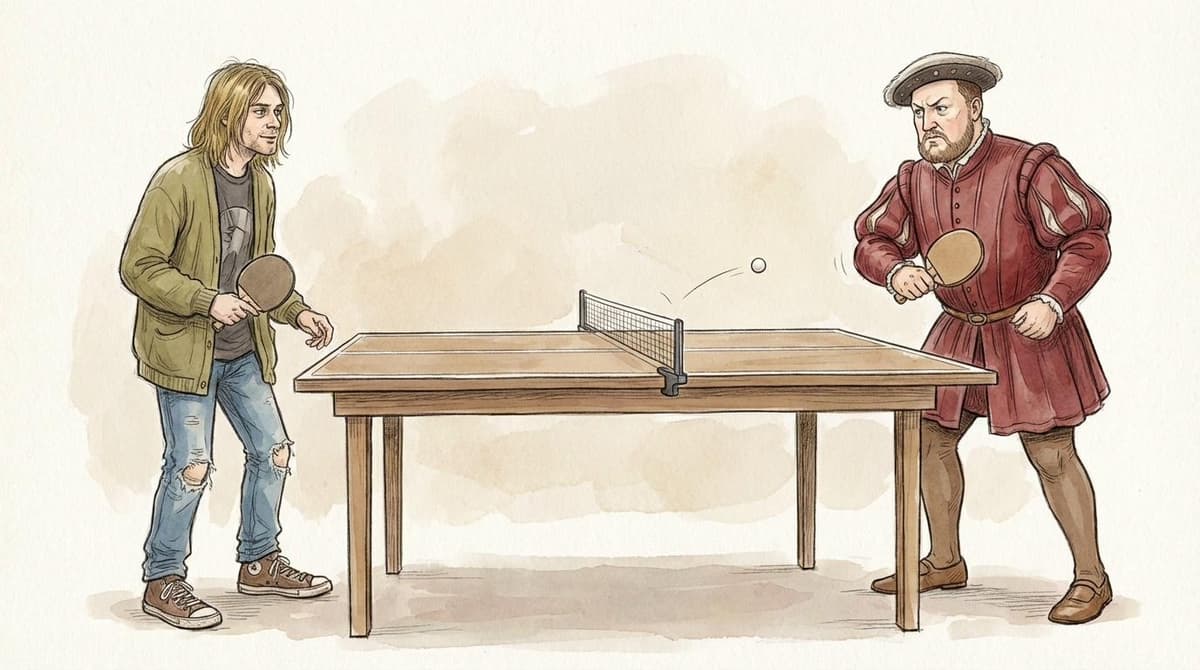
Kurt Cobain & Henry VIII
A grunge icon and a Tudor king discuss the weight of public expectation
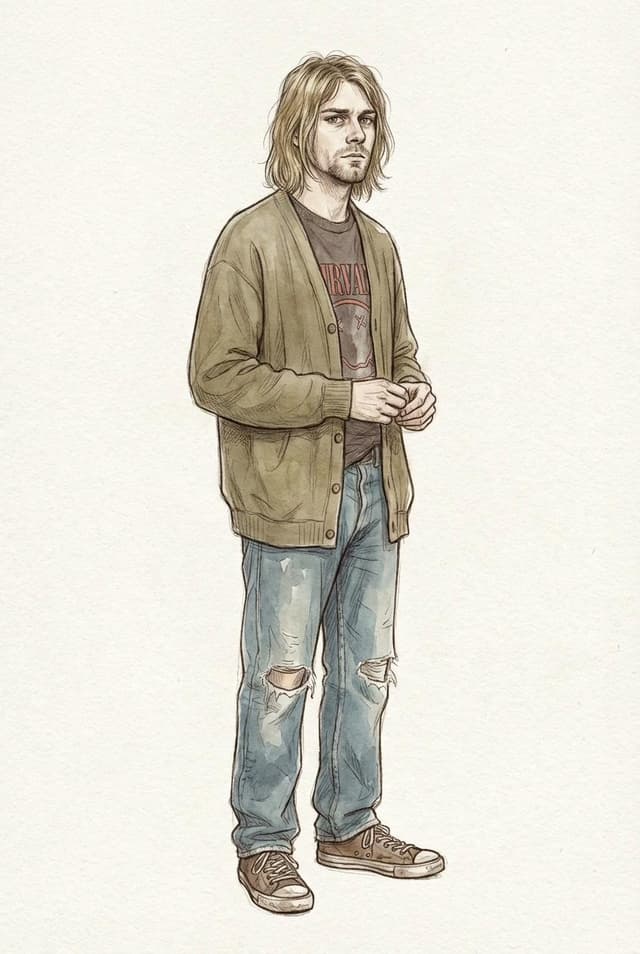

Kurt Cobain
1967–1994 · American
Lead singer of Nirvana who became the reluctant voice of Generation X. His raw lyrics and anti-establishment attitude defined the grunge movement.

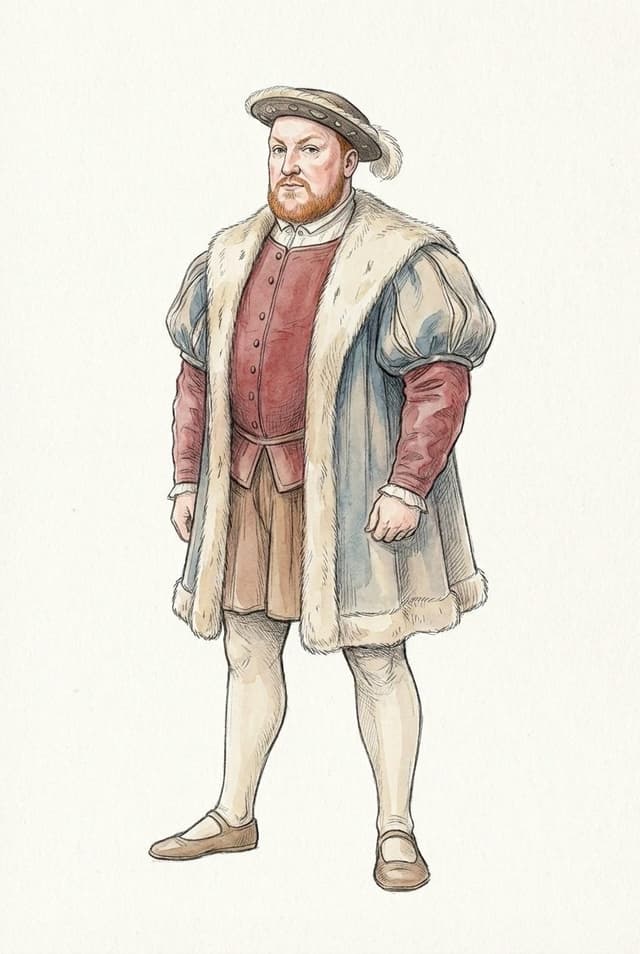
Henry VIII
1491–1547 · English
Tudor monarch who broke with Rome to establish the Church of England. Famous for his six marriages and transformation of English society.
Their Lifetimes
420 years apart Henry VIII
 Kurt Cobain
Unexpected Parallels
At first glance, a 16th-century king and a 20th-century rock star seem worlds apart. Yet both men found themselves trapped by the very power they achieved. Henry inherited a throne; Kurt accidentally created one. Both struggled with the gap between public expectation and private desire—Henry yearned for a simple heir, Kurt for simple obscurity. Where Henry's frustration reshaped a nation's religion, Kurt's disillusionment redefined a generation's sound. Both sought escape through their art: Henry composed courtly music; Kurt screamed into microphones. Most poignantly, both remain defined by their endings—one remembered for executing wives, the other for self-destruction—when each wanted to be remembered for what they built.
About Kurt Cobain
Kurt Donald Cobain grew up in Aberdeen, Washington, a small logging town where he felt perpetually out of place. His parents' divorce when he was nine left deep scars, and he bounced between relatives, sometimes sleeping under bridges. Music became his refuge—first as a listener obsessed with the Beatles and punk rock, then as a creator.
His music gave voice to a generation disillusioned with the excess of the 1980s, favouring authenticity over polish. Songs like "Smells Like Teen Spirit" became anthems not through calculation but through genuine emotional expression. Behind the music, Kurt battled chronic health issues, depression, and an uncomfortable relationship with his own fame. He often spoke of wanting simply to make music, not to be a spokesman. His death at 27 left an indelible mark on music history, but it's his art—honest, angry, and tender—that endures.
About Henry VIII
Henry VIII ascended to the English throne in 1509 as a golden boy: athletic, scholarly, and charming. Over his 38-year reign, he transformed from Renaissance prince to fearsome tyrant, reshaping England's religious and political landscape in ways still felt today.
His desperate quest for a male heir led to six marriages, two executions, and the English Reformation—a break with the Catholic Church that made him Supreme Head of a new Church of England. Beyond the famous wives, Henry was a complex figure: a patron of the arts who composed music, a theologian who debated doctrine, and an absolute ruler who consolidated royal power. His later years, marked by paranoia and physical decline, saw him become the bloated, suspicious figure of popular imagination. Yet his decisions shaped the modern British state, making him one of history's most consequential monarchs.
Shared Experiences
 🤝
🤝
- ✦ Turbulent childhoods that shaped their worldviews and left emotional scars carried into adulthood
- ✦ Struggled under the crushing weight of others' expectations, never feeling free to simply be themselves
- ✦ Found solace in music and artistic expression as an escape from the pressures of public life
- ✦ Chronic physical ailments that affected their temperament and decision-making throughout their lives
- ✦ Died before old age, leaving behind complicated legacies that continue to fascinate and divide opinion
Worlds Apart
Kurt's WorldHenry's World- ✦ Pain broadcast globally in real-time
- ✦ Modern medicine (distrusted it)
- ✦ Influence on every continent
- ✦ Instant access to all knowledge
- ✦ Fast food and coffee
- ✦ Messengers on horseback
- ✦ Physicians used leeches
- ✦ Reach extended to Europe
- ✦ Consulted the Bible
- ✦ Meals took hours to prepare
The Conversation